
The past five years have provided an expensive reminder that fixed income investments, including U.S. Treasury bonds, are not always synonymous with low risk.
An investor who allocated to long-duration Treasuries in 2021, traditionally viewed as a “safe” anchor within a diversified portfolio, would have suffered a cumulative -30% loss as interest rates increased sharply from historically low levels. Even the Bloomberg U.S. Aggregate, the benchmark that has come to define core fixed income for many private wealth portfolios, has generated a negative total return over the past five years.
The primary issue was not credit quality. Defaults among investment grade borrowers remained relatively limited. Instead, the problem was duration, or the sensitivity of a bond’s price to changes in interest rates. When rates increased faster and further than markets expected, long-duration assets experienced significant mark-to-market declines. In our view, this has been one of the most important lessons from the post-2021 fixed income market.
Perhaps most surprisingly, rates have continued to increase throughout 2026, defying market expectations. The change in the Treasury yield curve since the beginning of the year tells the story better than words ever could.
Exhibit 1: Change in the U.S. Treasury Yield Curve Since December 31, 2025

Source: U.S. Department of the Treasury, Daily Treasury Par Yield Curve Rates, as of December 31, 2025 and September 30, 2026.
Against that backdrop, we believe the debt tranches of collateralized loan obligations (“CLO”) deserve greater consideration within a diversified credit portfolio. CLO debt combines floating-rate income with structural protections and limited interest rate duration. Just as importantly, its risk profile differs meaningfully from both traditional fixed-rate bonds and direct lending.
A CLO is a diversified portfolio of senior secured corporate loans financed through multiple layers, or tranches, of debt and equity. The debt tranches of a CLO also feature floating interest rates, typically paying a credit spread over the 3-month Secured Overnight Financing Rate (“SOFR”). Unlike fixed-rate bonds, these floating-rate coupons adjust automatically as rates fluctuate and help protect against wild price swings.
A typical CLO may hold loans to hundreds of borrowers across a wide range of industries. Cash generated by those loans is distributed according to a defined priority of payments. The most senior AAA rated tranche is paid first, followed by the AA rated tranche, and then the remaining debt tranches. The equity tranche sits at the bottom of the capital structure and receives residual cash flows after the CLO’s debt obligations are satisfied.
Losses move in the opposite direction. Equity absorbs losses first, providing a cushion for the debt tranches above it. Historical default data illustrates the impact of these structural protections, with CLO debt experiencing lower cumulative default rates than similarly rated corporate debt across rating categories.
Exhibit 2: 15-Year Cumulative Default Rates by Asset Class and Rating

Source: Source: S&P, Nomura. Data as of December 2025.
Our current preferred investment is CLO BB debt, which sits relatively low in this capital structure but above the first-loss equity tranche. As a result, investors receive a wider credit spread than investors in more senior CLO debt. Importantly, BB remains a debt instrument with a contractual coupon and priority over CLO equity. In a typical structure, the equity tranche provides roughly 10% to 12% of first-loss protection, meaning the underlying loan portfolio would need to sustain losses of that magnitude before the BB tranche experiences permanent principal impairment.
CLOs also include structural tests intended to protect debt investors if collateral performance deteriorates. For example, if certain overcollateralization tests are breached, cash that otherwise would have been distributed to equity can instead be redirected toward paying down debt. In effect, the structure begins to deleverage as credit conditions weaken.
CLO debt carries risks, including credit, leverage and liquidity risk. These structural protections do not eliminate those risks, but they create an important distinction between CLO debt and simply owning a portfolio of similarly rated corporate credit.
Perhaps the most straightforward benefit of CLO debt is its floating-rate coupon.
As mentioned earlier, CLO debt typically pays a fixed credit spread over SOFR with the coupon resetting periodically. When short-term interest rates rise, the base rate component of the coupon rises as well. This produces very limited interest rate duration compared with traditional fixed-rate bonds.
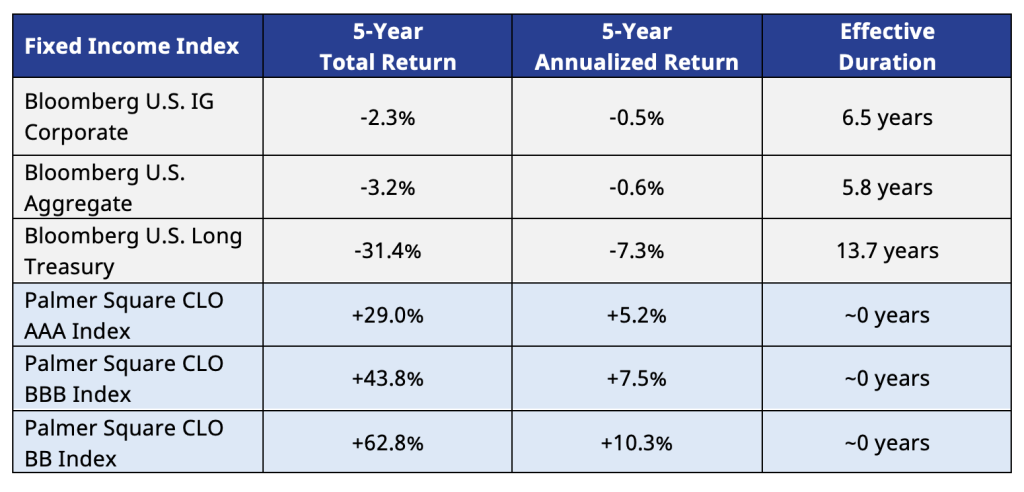
That distinction became especially important after 2021. As we mentioned earlier, long-duration Treasury and corporate bond investors experienced losses as interest rates increased. Floating-rate credit behaved differently because, absent significant credit deterioration, higher short-term rates translated into higher coupons rather than the duration-driven price declines.
Exhibit 3: Annualized Total Returns, 5 Years Ending September 30, 2026
Source: Bloomberg, as of September 30, 2026. Past performance is not indicative of future results. Indices are unmanaged and are not available for direct investment.
The difference in performance over this period illustrates the impact that duration can have on fixed income portfolios, especially during periods of volatile rate increases or elevated inflation expectations1.
Many market participants have tried and failed to predict the direction of interest rates in recent years. Even sophisticated investors can struggle to anticipate the wide range of factors that influence rates including monetary policy, inflation expectations, economic growth, fiscal policy, term premiums, and geopolitical developments.
Put simply, taking duration risk means making a bet on far more than just the Federal Reserve.
This is one reason we believe floating-rate credit can play a useful role in a diversified fixed income portfolio. An investor concentrated in long-duration fixed-rate bonds has meaningful exposure to often unpredictable changes in interest rates and the shape of the yield curve. CLO debt reduces that risk and uncertainty through floating interest rates.
Many private wealth investors have increased their allocations to direct lending over the past decade. That naturally raises a question: if an investor already owns private credit, does CLO debt simply provide more exposure to the same underlying risk?
We believe the two strategies can be complementary.
Direct lending typically involves direct and immediate exposure to individual middle market borrowers. Outcomes depend heavily on manager sourcing, underwriting, loan structure, and ongoing portfolio management. The portfolio may experience a loss if any single loan defaults, although equity beneath the loans provides important downside protection.
CLO debt takes a different approach. Investors gain exposure to a diversified portfolio of broadly syndicated loans through a securitized structure. Like direct loans, the underlying loans benefit from borrower equity beneath them in the capital structure. CLO debt adds another layer of protection, with the CLO equity tranche absorbing portfolio losses before they reach the BB tranche.
Diversification is another meaningful difference. An allocation across multiple CLO debt securities can create look-through exposure to a very large number of corporate borrowers and CLO managers. CLO debt generally trades in an established institutional secondary market, although liquidity can become limited during periods of market stress, a meaningful distinction from individual private loans, which may rarely trade.
Taken together, these characteristics make CLO debt less of a substitute for direct lending and more of a complementary source of floating-rate credit exposure.
The past several years have demonstrated that fixed income portfolios can carry significant risk even when underlying credit quality remains sound. Duration was a primary offender.
We believe CLO debt offers a differentiated approach. Its floating-rate structure limits exposure to interest rate duration, while CLO subordination and structural tests provide layers of protection against deterioration in the underlying loan portfolio.
For investors already allocating to traditional fixed income and private credit, CLO debt may provide another source of diversified credit exposure without simply replicating the same risks.
The next five years will almost certainly look different from the last five. At PennantPark, we won’t try to predict exactly how. Instead, our focus is on building attractive portfolios that harness the benefits of floating-rate debt, limit duration risk, and provide resilience when markets inevitably surprise us.
Considering how CLO debt could fit within your clients’ broader credit allocations? We welcome a conversation. Please contact invest@pennantpark.com or the professionals listed below.
PennantPark was founded in 2007 as an independent middle market credit platform. The firm was founded by Art Penn, a private credit industry veteran that previously co-founded Apollo Investment Management. We have invested over $27 billion across multiple economic and credit cycles since inception, and we manage $10 billion in AUM today.1 PennantPark serves a broad range of sophisticated investors with product offerings that include business development companies, private capital funds, joint ventures, and other specialized funds.
Our highly experienced team primarily invests in the core middle market, targeting companies with earnings of $10 million to $50 million. These mid-sized companies are often overlooked by banks and large investment managers, resulting in senior secured loans that generally feature higher yields, lower leverage, and stronger lender protections when compared to the upper middle market and broadly syndicated loans. We focus on five key industry verticals where we have the most expertise and experience. These industries include healthcare, government services, business services, consumer, and software & technology2.



[1] The period shown coincided with a significant increase in interest rates. Different market environments may produce materially different results, including periods in which CLO debt underperforms traditional fixed income investments.
[2] Assets under management (“AUM”) is defined as the sum of gross asset values, unfunded commitments, joint ventures and undrawn available leverage for active funds as of 3/31/2026. Invested capital represents the cumulative sum of capital invested across the PennantPark platform since inception through 3/31/2026. Figures are rounded to the nearest billion.
©2026 PennantPark Investment Advisers, LLC (‘PennantPark’) is an investment adviser registered with the US Securities and Exchange Commission (‘SEC’). Registration is not an endorsement by the SEC nor an indication of any specific level of skill. The material included in this document is intended for informational purposes only. Products or services referenced in this document may not be licensed in all jurisdictions, and unless otherwise indicated, no regulator or government authority has reviewed this document, or the merits of the products and services referenced herein. This document and the information contained herein has been made available in accordance with the restrictions and/or limitations implemented by applicable laws and regulations.
In considering the past performance information contained herein, recipients should bear in mind that past performance is not a guarantee, projection or prediction and it is not a guarantee or indication of future results. Invested capital is at risk. There can be no assurance that any product or service referenced herein will achieve comparable results, or that they will be able to implement their investment strategies or achieve their investment objectives.
An investment with PennantPark in any advised fund is suitable only for sophisticated investors and requires the financial ability and willingness to accept the risks and lack of liquidity that are characteristic of an investment in such funds. Investors must be prepared to bear such risks for an extended period. There can be no assurance that any investment will be profitable, not lose money, or achieve the other intended purposes for which they are made. Investing with PennantPark will expose the investor to various risks including, but not limed to, the following: 1) Lack of Liquidity Risks including lack of permitted withdrawals, lack of secondary market, and lack of transferability 2) Interest Rate Volatility Risks 3) Use of Leverage Risks 4) Securitization Risks 5) Credit Market Disruption Risks 6) Investing within a Highly Competitive Market Risks 7) Default by Borrowers Risks 8) Recovery on Bad Debt Risks including cost of recovery 9) International Market Exposure Risks 10) Inflation and Deflation Exposure Risks. This is not intended to be a complete description of the risks of investing with PennantPark. 11) Political and Government Policy Risks.
The information contained here does not constitute, and is not intended to constitute, an offer of securities and accordingly should not be construed as such. Any such offering of a Pennant Park fund can be made only at the time a qualified offeree receives a confidential private offering memorandum, prospectus and/or other operative documents which contain significant details with respect to risks and which should be carefully read. All information contained in this presentation is qualified in its entirety by each fund’s operative documents. Investors should rely on their own examination of the potential risks and rewards. The firm brochure (Form ADV 2A) is available online at www.adviserinfo.sec.gov or upon request and also discusses these and other important risk factors and considerations that should be carefully evaluated before making an investment. Information in this document does not constitute legal, tax, or investment advice. Before acting on any information in this document, current and prospective investors should inform themselves of and observe all applicable laws, rules and regulations of any relevant jurisdictions or obtain independent tax, legal, or investment advice.
This document may not be reproduced and may not be redistributed to any party without prior written consent. Statements in this document are made as of the date hereof unless stated otherwise herein, and neither the delivery of this document at any time, nor any sale hereunder, shall under any circumstances create an implication that the information contained herein is correct as of any time after such date. Certain information contained herein concerning economic trends and performance is based on or derived from information provided by independent third-party sources. PennantPark believes that such information is accurate and that the sources from which it has been obtained are reliable. PennantPark cannot guarantee the accuracy of such information, however, and has not independently verified the assumptions on which such information is based. Certain statements contained in this document, including without limitation, statements containing the words “believes,” “anticipates,” “intends,” “expects,” and words of similar import constitute “forward looking statements.” Additionally, any forecasts and estimates provided herein are forward-looking statements. Such statements and other forward-looking statements are based on available information and the views of PennantPark as of the date hereof. Accordingly, such statements are inherently speculative as they are based on assumptions that may involve known and unknown risks and uncertainties. Actual results and events may differ materially from those in any forward-looking statements. Further, any opinions or analysis expressed are the current opinions or analysis of PennantPark only, are not guaranteed, and may be subject to change, without notice. There is no undertaking to update any of the information in this document. No person has been authorized in connection with this document to give any information or to make any representations other than as contained in this document and, if given or made, such information or representation must not be relied upon as having been authorized by PennantPark or PennantPark’s affiliates.