
Private credit has become a core allocation, but most wealth portfolios remain concentrated in a handful of direct lending strategies with the largest investment firms. CLO debt offers a differentiated way to broaden that exposure.
BB-rated CLO tranches pair floating-rate income with the structural defense of subordinated equity that absorbs losses first and have historically carried spreads roughly 400 to 500 basis points wider than similarly rated corporate loans.
CLO BB notes have delivered a 15-year default rate of 1.1% vs. 5.2% on similar rated corporate bonds.1
CLO BBs have shown low or even negative correlation to investment grade and high yield bonds, a genuine diversification benefit for traditional fixed income sleeves.
Spreads sit near their widest level in over two years. In prior episodes of similar widening, CLO BBs went on to deliver double-digit annualized returns over subsequent multi-year periods.2
PennantPark Enhanced Income Fund (“PNTIX”) provides selective access to CLO tranche investing: monthly distributions3, 1099 tax reporting, IRA eligibility, and limited liquidity available quarterly.
For years, private credit has been one of the fastest-growing corners of the alternatives market. It has evolved from an institutional niche into a core allocation, driven by the search for income, downside management, and diversification. As more investors have embraced it, a problem has quietly taken root in many private wealth portfolios: concentration risk.
Most individual investors who hold private credit are concentrated in two ways at once. Their capital sits with a small number of the very largest managers, and it is largely invested in traditional direct lending to upper middle market companies. The result is an allocation that often looks diversified on paper but is exposed to a narrow segment of the loan market.
An allocation to collateralized loan obligation (“CLO”) debt can reduce this concentration risk by providing exposure to a different segment of the credit market, spreading capital across many underlying loans and collateral managers, and introducing a distinct risk and return profile. For investors seeking current income that behaves differently from what they already own, CLO debt, and specifically its mezzanine debt tranches, deserves a closer look.
Understanding why the structure is generally resilient helps explain the rest of the case. A CLO raises debt and equity to buy a diversified pool of primarily first-lien loans. Principal and interest flow to investors in order of seniority, and a series of structural features (including over-collateralization tests, industry and issuer concentration limits, CCC-rated loan caps, and excess spread) work to shield debt holders before losses ever reach them. They are a valuable tool that allows a portfolio of homogeneous loans to be securitized into multiple tranches to meet the return and risk needs of various investor types.
Despite decades of history, CLOs still carry baggage from the 2008 financial crisis, much of it the result of mistaken identity. A few clarifications matter before going further, because the misconceptions are precisely what create an attractive investment opportunity.
PennantPark’s core conviction in PNTIX is concentrated in CLO BB debt. The reasoning rests on a persistent and well-documented pricing gap.
The BB tranche sits near the bottom of the CLO capital structure, though there is still a meaningful equity cushion absorbing potential first losses. BB-rated CLO tranches have historically carried spreads roughly 400 to 500 basis points wider than similarly rated corporate loans and bonds. That premium does not exist because the credit is somehow worse or riskier. Instead, it persists because the market is less liquid and the investor base is constrained by the misperceptions described above. In other words, CLO investors are paid both a liquidity premium and an information premium compared to similarly rated bonds.
Regarding the liquidity premium, it is true that CLO debt tends to be less liquid than many investment grade and high yield bonds. However, CLO debt tranches are usually more liquid than the private credit loans in direct lending funds. Through the combination of market liquidity and daily marks, portfolio managers like PennantPark are better able to optimize their CLO portfolios through active management. In addition, investors in CLO funds can rest assured that daily NAV calculations are supported by market quotes or third-party valuations rather than manager discretion.
The historical default experience further reinforces the point that CLO debt has historically offered attractive relative value. Looking across a fifteen-year window, cumulative default rates for CLO debt have run dramatically below those of similarly rated corporate debt at every rung of the rating scale. The gap at the BB level is striking, and it traces directly back to the structural safeguards described above: subordination, concentration limits, quality tests, active management, and cash-flow diversion triggers that redirect cash to senior holders when a deal comes under stress.
PNTIX invests in BB tranches across both broadly syndicated loan (BSL) CLOs and middle market (MM) CLOs, and the ability to move between the two is part of what differentiates the fund. The middle market piece is where PennantPark’s two decades of direct-lending experience becomes a genuine advantage.
The core middle market (companies with roughly $10 to $50 million of EBITDA) is simply less crowded than the largest segments of the credit market. Smaller loans do not move the needle for the biggest lenders, so fewer firms compete for them. That dynamic has historically translated into better terms for lenders, and it shows up clearly in the loan profiles backing MM CLOs6:
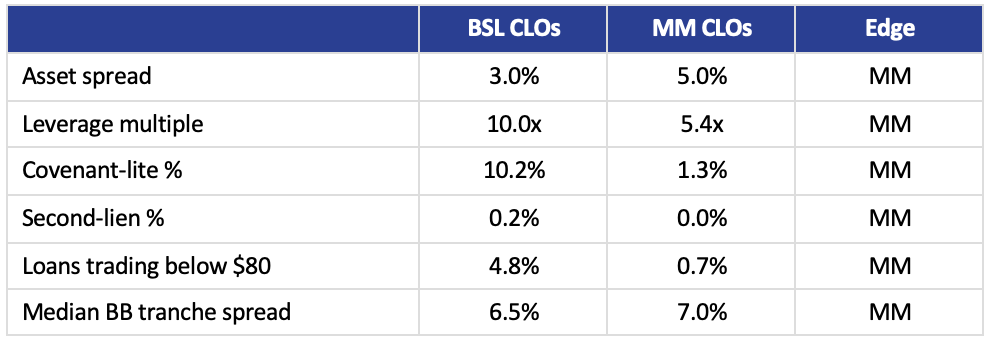
The difference is striking. The BB tranches of MM CLOs are able to pay higher spreads despite significantly less structural leverage, fewer covenant-lite loans, fewer second lien loans, and fewer stressed loans trading under $80. These disparities demonstrate the value of focusing on a less competitive segment of the market.
PennantPark’s role as a BB regular issuer of middle market CLOs sharpens this further. The firm has issued 12 middle market CLOs totaling roughly $4 billion, which provides three practical advantages when investing in third-party deals: deep insight into the track records and behavior of CLO collateral managers; the experience to assess underlying loan portfolios accurately; and arranger relationships that improve access to new issuance. An investor buying CLO BBs through PNTIX is, in effect, drawing on a manager whose experience sits on both sides of the market.
One structural point is worth highlighting for advisors comparing options. Most CLO funds confine themselves to either BSL or middle market strategies, and a large share of competing assets sit in CLO equity. PNTIX is one of relatively few strategies that focuses on the BB tranche while dynamically allocating across both BSL and middle market CLOs, deliberately steering away from the equity-heavy positioning common elsewhere.
It can be difficult to time any market. That said, CLO BB spreads recently widened to their widest level in over two years.
That is worth dwelling on, because history offers a relevant pattern. Over the past fifteen years, there have been four other episodes when average CLO BB spreads widened to roughly 8% or more. In each case, investors who bought into that widening were rewarded over the following years. Measured across those four starting points, CLO BBs delivered double-digit annualized gross returns on average over subsequent one-, two-, three-, and five-year horizons.7
There is certainly risk that spreads can widen further, but history suggests that today is a good time to begin allocating to CLOs for patient investors. In many respects, the distinction between proactive and reactive credit management is tied directly to reporting access and lender visibility. Managers with direct relationships and smaller lender groups are often better positioned to respond quickly during periods of stress.
A compelling asset class is only useful if clients can access it cleanly. That was a challenge for CLO tranches for a long time, but recent innovations have removed most of the friction for individual investors. Specifically, PNTIX offers:
Private wealth investors have embraced private credit over the past several years, but many allocations remain concentrated in ways their owners may not fully appreciate. CLO BB debt offers a differentiated path: floating-rate income, a return stream that has historically behaved differently from traditional bonds, structural risk mitigations that have contributed to low historical default rates, and a spread premium that may reward investors willing to look past old misconceptions.
For private wealth clients seeking income and thoughtful diversification, PNTIX is designed to make that exposure straightforward to own. At PennantPark, we believe successful investing begins with understanding where risk is being taken and how it is being managed. That philosophy has guided us through multiple cycles, and it shapes how we think about the opportunity ahead.
For advisors considering CLO debt as a complement to their clients’ fixed income allocations, we welcome a conversation. Please contact invest@pennantpark.com or the professionals listed below.
PennantPark was founded in 2007 as an independent middle market credit platform. The firm was founded by Art Penn, a private credit industry veteran that previously co-founded Apollo Investment Management. We have invested over $27 billion across multiple economic and credit cycles since inception, and we manage $10 billion in AUM today.8 PennantPark serves a broad range of sophisticated investors with product offerings that include business development companies, private capital funds, joint ventures, and other specialized funds.
Our highly experienced team primarily invests in the core middle market, targeting companies with earnings of $10 million to $50 million. These mid-sized companies are often overlooked by banks and large investment managers, resulting in senior secured loans that generally feature higher yields, lower leverage, and stronger lender protections when compared to the upper middle market and broadly syndicated loans. We focus on five key industry verticals where we have the most expertise and experience. These industries include healthcare, government services, business services, consumer, and software & technology.


[1] Source: S&P, Nomura. Share of US BSL CLO tranches ever rated by S&P that have defaulted; as of Dec 2025; Corporate Bonds: Average cumulative default rates for US corporates, 1981-2024.
[2] Source: As of 3/12/2026.Palmer Square CLO BB Discount Margin Spread Floor Index (“PSBBDMSF Index”). Prior episodes of comparable spread widening are based on historical CLO BB discount margin levels, with subsequent returns measured using Palmer Square CLO BB total return data over the following multi-year periods. The analysis is for illustrative purposes only, does not represent any actual investment, and should not be viewed as a forecast. Past performance is not indicative of future results.
[3] Monthly distributions are not guaranteed and may be reduced, suspended, or discontinued at any time. Past distributions are not indicative of future results. No Shareholder will have the right to require the Fund to redeem its shares. There is no assurance that investors will be able to tender their shares when or in the amount desired.
[4] Source: S&P, Nomura. Share of US BSL CLO tranches ever rated by S&P that have defaulted; as of Dec 2025; sole AA default had rating lowered to D after the trustee escrowed the note’s interest payments but ultimately saw no economic loss.
[5] Based on PennantPark analysis of daily total return data from December 31, 2015 through December 31, 2025. CLO BB volatility and returns are calculated using the Palmer Square CLO BB Index (Bloomberg: PCLOBBTR Index); S&P 500 figures use the S&P 500 Total Return Index (Bloomberg: SPXT Index). Annualized volatility is the standard deviation of daily returns scaled to an annual basis; Sharpe ratios are calculated using excess returns over the 3-month U.S. Treasury bill rate (Bloomberg: USGG3M Index). Over this period, CLO BBs exhibited annualized volatility of approximately 7.5% and a Sharpe ratio of 1.26, versus approximately 18.1% volatility and a Sharpe ratio of 0.72 for the S&P 500. Source: PennantPark internal analysis, Bloomberg.
[6] Industry averages. Source: Valitana, as of 12/31/2025. For illustrative purposes only.
[7] Source: As of 3/12/2026.Palmer Square CLO BB Discount Margin Spread Floor Index (“PSBBDMSF Index”). Prior episodes of comparable spread widening are based on historical CLO BB discount margin levels, with subsequent returns measured using Palmer Square CLO BB total return data over the following multi-year periods. The analysis is for illustrative purposes only, does not represent any actual investment, and should not be viewed as a forecast. Past performance is not indicative of future results
Note: Past performance is not necessarily indicative of future results. Invested capital is at risk. There can be no assurance that the fund will be able to implement its investment strategy or achieve its investment objectives. Monthly distributions are not guaranteed. No Shareholder will have the right to require the Fund to redeem its shares. There is no assurance that investors will be able to tender their shares when or in the amount desired.
[8] Assets under management (“AUM”) is defined as the sum of gross asset values, unfunded commitments, joint ventures and undrawn available leverage for active funds as of 3/31/2026. Invested capital represents the cumulative sum of capital invested across the PennantPark platform since inception through 3/31/2026. Figures are rounded to the nearest billion.
Important Information:
Investors should consider the investment objectives, risks, and charges and expenses of the Fund before investing. The prospectus contains this and other information about the Fund and should be read carefully before investing. The prospectus may be obtained by calling, (833) 635-6839, or at www.pennantparkenhanced.com.
The Fund is Distributed by Ultimus Fund Distributors, LLC, Member FINRA/SIPC. PennantPark Investment Advisers, LLC is not affiliated with Ultimus Fund Distributors, LLC.
Important Risks:
The Fund is newly formed and has limited operating history. Investing in the PennantPark Enhanced Income Fund involves significant risk, including possible loss of all or part of your investment. The value of the fund’s shares, when redeemed, may be worth more or less than their original cost.
Past performance is no guarantee of future results. There is no guarantee that any investment strategy will achieve its objectives, generate profits or avoid losses. The Fund is non-diversified, which means it may be invested in a limited number of issuers and susceptible to any economic, political and regulatory events than a more diversified fund.
Rising interest rates may adversely affect the value of our portfolio investments, which could have an adverse effect on our business, financial condition and results of operations. The Fund is subject to inflation risk, counterparty risk, prepayments and calls, increasing re-investment risk.
Liquidity Risks: The Fund is suitable only for investors who can bear the risks associated with the Fund’s limited liquidity and should be viewed as a long-term investment. Investors must be prepared to bear the Fund’s risks for an extended period of time. In order to provide some liquidity to our shareholders, we offer to repurchase our outstanding shares on a quarterly basis. Our repurchase offers are conducted pursuant to a fundamental policy, pursuant to which we offer to repurchase no less than 5% of our outstanding shares on a non-discretionary basis once each calendar quarter of each year. Although we will make quarterly repurchase offers, there is no guarantee that an investor will be able to sell all the shares that the investor desires to sell in the repurchase offer, and thus investors should consider our shares to be of limited liquidity. In addition, there is no secondary market for the Fund’s shares and none is expected to develop.
Investment Risks: The Fund will focus on investments in floating rate junior debt tranches issued by collateralized loan obligation (“CLO”) vehicles, and to a lesser extent CLO equity tranches, each of which are exposed to interest rate risk. Substantial increases in interest rates may cause an increase in loan defaults and the value of the Fund’s assets may also be affected by other uncertainties such as economic developments affecting the market for senior secured term loans or uncertainties affecting borrowers generally. There can be no assurance that any investments will be profitable, not lose money, or achieve the other intended purposes for which they are made. The CLO securities in which the Fund invests are subject to a high degree of special risks including: 1) our investments in CLOs may be riskier and less transparent to us and our shareholders than direct investments in the underlying companies; 2) the Fund may leverage itself by borrowing money and the tranches the Fund invests in are themselves leveraged; 3) Leverage increases the volatility of the Fund and magnifies the effect of defaults, or expected defaults, on the Fund’s investments and potential cash distributions; and 4) the complex structure of the CLO investment may not be fully understood at the time of investment and may produce disputes with the issuer, holders of senior tranches or other unexpected investment results.
The Senior Secured Loans underlying our CLO investments typically will be rated BB or B, or to a lesser extent, CCC or unrated, by nationally recognized rating agencies. In addition, the Fund’s investments are typically rated BB or B, which are below investment grade. Non-investment grade or “junk” securities are predominantly speculative with respect to the issuer’s capacity to pay interest and repay principal when due and therefore involve a greater risk of default and higher price volatility than investment grade debt. Senior Secured Loans are subject to prepayment risk, where the debtor pays its obligation early, potentially reducing the amount of interest available for distribution from CLO vehicles. We may invest in business development companies and private investment funds, including but not limited to private debt funds and private real estate funds, managed by unaffiliated institutional asset managers, and our performance depends in part upon the performance of the private investment fund managers and selected strategies. This is a “blind pool” offering and thus you will not have the opportunity to evaluate the Fund’s investments before the Fund makes them.
Risks of investing in the Fund is not limited to those discussed above. Shareholders should refer to the Fund prospectus for a complete listing of principal risks of investing in the Fund and rely on their own examination of the potential risks and rewards.
The information contained in this Presentation does not constitute and is not intended to constitute an offer of securities and accordingly should not be construed as such. Any products or services referenced in this Presentation may not be licensed in all jurisdictions, and unless otherwise indicated, no regulator or government authority has reviewed this document or the merits of the products and services referenced herein. This Presentation and the information contained herein has been made available in accordance with the restrictions and/or limitations implemented by any applicable laws and regulations.
Furthermore, this Presentation is provided for informational purposes only and may not be reproduced in any form. Before acting on any information in this Presentation, current and prospective investors should inform themselves of and observe all applicable laws, rules and regulations of any relevant jurisdictions and obtain independent advice if required.
No person has been authorized in connection with this offering to give any information or to make any representations other than as contained in this Presentation and, if given or made, such information or representation must not be relied upon as having been authorized by PennantPark Investment Advisers, LLC (“PennantPark”) or PennantPark’s affiliates. Statements in this Presentation are made as of the date hereof unless stated otherwise herein, and neither the delivery of this Presentation at any time, nor any sale hereunder, shall under any circumstances create an implication that the information contained herein is correct as of any time subsequent to such date.
In considering the prior performance information contained herein, recipients should bear in mind that past performance is not a guarantee, projection or prediction and it is not necessarily indicative of future results. Invested capital is at risk. There can be no assurance that any product or service referenced herein will achieve comparable results, or that they will be able to implement their investment strategies or achieve their investment objectives.
Certain statements contained in this Presentation, including without limitation, statements containing the words “believes,” “anticipates,” “intends,” “expects,” and words of similar import constitute “forward looking statements.” Additionally, any forecasts and estimates provided herein are forward looking statements. Such statements and other forward-looking statements are based on available information and the views of PennantPark as of the date hereof. Accordingly, such statements are inherently speculative as they are based on assumptions that may involve known and unknown risks and uncertainties. Actual results and events may differ materially from those in any forward-looking statements. Further, any opinions expressed are the current opinions of PennantPark only and may be subject to change, without notice. There is no undertaking to update any of the information in this document.
Certain information contained herein concerning economic trends and performance is based on or derived from information provided by independent third-party sources. PennantPark believes that such information is accurate and that the sources from which it has been obtained are reliable. PennantPark cannot guarantee the accuracy of such information, however, and has not independently verified the assumptions on which such information is based.
References to “$,” “USD” or “dollars” throughout this Presentation are to United States dollars unless the context indicates otherwise.
Glossary Terms
ACT/360
ACT/360 is a day-count convention that calculates interest using the actual number of days in a period divided by 360. It is commonly used in money markets and short-term rate calculations.
Annualized Distribution Yield
Annualized distribution yield refers to the projected annual income an investor would receive based on the most recent distribution, expressed as a percentage of the current investment price or value.
Basis Points (bps)
Basis points are a unit of measurement used to describe changes in interest rates, yields, or spreads, where one basis point equals 0.01% (one one-hundredth of a percent). They provide a precise way to express small changes in financial metrics.
BB-Rated CLO Tranches
BB-rated CLO tranches are below-investment-grade debt securities issued by a collateralized loan obligation that sit near the bottom of the CLO debt capital structure, above the equity tranche.
Bloomberg S&P BDC Index
The Bloomberg S&P BDC Index measures the performance of publicly traded U.S. Business Development Companies (BDCs), including share price changes and dividends.
Bloomberg US Aggregate Bond Index
The Bloomberg US Aggregate Bond Index is a broad, market-value-weighted index designed to measure the performance of the U.S. investment grade taxable bond market, including government, corporate, mortgage-backed, and asset-backed securities. The index is unmanaged, does not reflect fees or expenses, and is not available for direct investment.
Bloomberg US High Yield Index
The Bloomberg US High Yield Index is a market-value-weighted index designed to measure the performance of U.S. dollar-denominated, below-investment-grade corporate bonds publicly issued in the U.S. domestic market. The index is unmanaged, does not reflect fees or expenses, and is not available for direct investment.
Breakeven Annual Default Rate
The level of loan defaults per year that would reduce returns to zero, after accounting for interest income and recoveries.
Broadly Syndicated Loans (BSL)
Broadly Syndicated Loans are large corporate loans arranged by one or more financial institutions and syndicated to a broad group of institutional investors. Although these loans may trade in a secondary market, such markets may be limited or illiquid, particularly during periods of market stress.
Business Development Companies (BDCs)
Business Development Companies are investment vehicles that provide financing to middle market companies, typically through loans and equity investments. They offer investors access to private credit markets and aim to generate income. The vehicles are subject to credit and market risks associated with lending to smaller, non-investment grade businesses.
CCC-Rated Loan Limits
CCC-rated loan limits are portfolio guidelines that restrict the amount of lower-rated (higher-risk) loans held within a credit portfolio, helping manage overall credit risk.
CCC-Rated Loan Caps
A limit in most CLO indentures on the percentage of the portfolio that may consist of CCC-rated (or lower) loans, typically 5–7.5%. Loans above this cap are valued at the lower of market or par for overcollateralization test purposes, which can reduce cash flow to equity and junior tranches.
Cliffwater BDC Index
The Cliffwater BDC Index is an index designed to measure the performance of publicly traded business development companies in the United States. The index is unmanaged, does not reflect fees or expenses, and is not available for direct investment.
CMBS BBB Bonds
CMBS BBB bonds are commercial mortgage-backed securities rated BBB, the lowest investment-grade category. They are backed by commercial real estate loans and typically offer higher yields but carry greater credit risk.
Collateralized Debt Obligations (CDOs)
Collateralized Debt Obligations are structured investments that pool together debt assets, such as loans or bonds, and issue different classes of securities with varying levels of risk and return.
Collateralized Loan Obligations (CLOs)
Collateralized Loan Obligations are structured investment vehicles that hold portfolios of senior secured corporate loans and issue multiple classes of securities with different levels of risk, return, and priority of payment.
CLO 2.0 (and later CLO 3.0)
Terms used to describe post-2008 CLO structures with enhanced investor protections compared to pre-crisis (“CLO 1.0”) deals, including stricter collateral quality tests, lower leverage, and improved documentation. CLO 3.0 refers to structures issued after 2013 that further incorporated Volcker Rule and risk-retention requirements.
Compound Annual Growth Rate (CAGR)
CAGR measures the average annual rate of return of an investment over time, assuming returns are reinvested and growth occurs at a steady rate.
Correlation
A measure of how two assets move relative to each other. It ranges from negative 1 to positive 1, where higher values mean the assets move together and lower or negative values indicate greater diversification benefits.
Covenant-Lite (Cov-Lite) Loans
Covenant-lite loans are loans that have few or no ongoing financial covenants, limiting a lender’s ability to intervene early if a borrower’s financial condition weakens.
Discount Margin to Call
The expected annual return on a loan assuming the borrower repays early (at the first call date), adjusted for any discount or premium paid when buying the loan.
Discount Margin to Maturity
The expected annual return on a loan if it is held all the way until final repayment, adjusted for the price paid (discount or premium).
EBITDA
Earnings before interest, taxes, depreciation, and amortization. A commonly used measure of a company’s operating cash flow and debt-servicing capacity, often used in leverage ratios and covenant calculations for corporate loans.
First Lien Loans
First lien loans are secured loans that have a first-priority claim on a borrower’s assets. They are typically lower risk than other types of debt but still carry credit risk.
Investment Grade
Investment Grade refers to debt securities that are rated in the higher-quality tiers by recognized credit rating agencies, indicating a relatively low risk of default. These ratings typically range from AAA to BBB- (or equivalent) and suggest that the issuer has a strong capacity to meet its financial obligations.
Leverage
The use of borrowed money (debt) to finance investments or business operations. Leverage can amplify returns when investments perform well, but it can also increase losses if performance deteriorates.
Leveraged Loans
Loans made to companies that already have a higher amount of debt relative to their earnings. These loans typically offer higher interest rates to compensate investors for the increased risk and are often used to finance acquisitions, growth initiatives, or refinancings.
Mezzanine / Subordinated Debt
Subordinated Debt is a form of borrowing that ranks below senior secured and other higher-priority debt in a borrower’s capital structure. While it may offer higher potential returns, it is subject to greater credit risk, including the possibility that repayment may be limited or unavailable in a default scenario.
Middle Market Loans (MM)
Middle Market Loans are loans made to companies that are generally smaller than large, publicly traded companies, as defined by the Adviser using financial metrics such as Earnings Before Interest, Taxes, Depreciation, and Amortization (EBITDA). These loans may involve higher credit, liquidity, and valuation risks than loans to larger companies.
Mid-Sized Companies
Mid-sized companies are businesses that are generally smaller than large, publicly traded corporations, as defined by the Adviser using financial metrics such as Earnings Before Interest, Taxes, Depreciation, and Amortization (EBITDA).
Morningstar LSTA US Leveraged Loan Index
The Morningstar LSTA US Leveraged Loan Index is a market-value-weighted index designed to measure the performance of the U.S. leveraged loan market, including broadly syndicated, senior secured, floating-rate loans. The index is unmanaged and does not reflect fees or expenses.
Palmer Square CLO BB Index
The Palmer Square CLO BB Index is an index designed to measure the performance of U.S. dollar-denominated BB-rated collateralized loan obligation debt tranches. The index is unmanaged, does not reflect fees or expenses, and is not available for direct investment.
Par Subordination
The percentage of a company’s capital structure that sits below your loan and absorbs losses first.
Rated Loans
Rated Loans are loans that have been assigned a credit rating by an independent rating agency based on the borrower’s creditworthiness and the terms of the loan. These ratings provide a standardized assessment of risk, helping investors evaluate the likelihood of repayment and compare loans across issuers. Ratings range from AAA as the highest credit quality rating to D as the lowest credit quality rating.
S&P 500 Index
The S&P 500 is a widely followed stock market index that tracks the performance of 500 of the largest publicly traded companies in the United States. It is commonly used as a benchmark for the overall U.S. equity market and provides investors with broad exposure to leading businesses across a range of industries.
Second Lien Loans
Second Lien Loans are secured loans that have a second-priority claim on specified collateral in a borrower’s capital structure. While they rank behind first lien loans, they remain senior to unsecured obligations and are subject to credit risk and the possibility that collateral values may be insufficient in a default.
Senior Secured Corporate Loans
Senior Secured Corporate Loans are loans made to corporations that are secured by collateral and rank senior in the borrower’s capital structure to unsecured or subordinated debt. These loans generally have priority in repayment but are still subject to credit, collateral, and liquidity risks.
Sharpe Ratio
The Sharpe Ratio is a measure of risk-adjusted return that evaluates how much excess return an investment generates for each unit of risk taken. It compares a portfolio’s return above a risk-free rate to its volatility, helping investors assess whether higher returns are being achieved efficiently.
Stressed Loans
Loans trading or performing at levels indicating heightened credit risk, typically reflected in a lower market price or rating (often CCC or below) but not yet in default. Stressed loans may face an elevated risk of future default or restructuring.
Subordination
The portion of a CLO’s capital structure below a given tranche that absorbs losses first, providing credit support to more senior tranches. Greater subordination generally means lower risk (and lower yield) for a given tranche.
Tranches (CLO Debt and CLO Equity)
Tranches are classes of securities issued by a collateralized loan obligation that have different priorities of payment and risk exposure. CLO debt tranches generally receive payments before CLO equity tranches, while CLO equity represents the most junior interest and is subject to the highest risk of loss.
Weighted Average Spread
The average interest margin (spread) across all loans in a portfolio, weighted by their size.