
In 2024, 84% of all private credit capital raised flowed to mega-managers, many of whom compete for a relatively limited number of transactions in the upper middle market.1 As a result, capital supply in that segment has increasingly outpaced opportunity, intensifying competition and compressing returns.
By contrast, the core middle market represents a significantly broader and less crowded investment universe. Beyond offering more attractive risk-adjusted returns, managers that focus on this segment gain access to a deeper pool of opportunities with greater potential for diversification.
1 Pitchbook. 2024 Annual Global Private Debt Report.
The upper middle market encompasses a relatively small population of companies, which has created a highly competitive environment for lenders. In this segment, many financings take the form of syndicated loans, with multiple managers participating in the same transaction. While this structure can provide diversification within a single fund, it often results in substantial overlap across managers and portfolios at the industry level.
For advisors constructing private credit allocations across several large platforms, this dynamic can lead to portfolios that look more similar than expected. Separate managers may appear distinct at the surface level, yet ultimately hold exposure to many of the same underlying borrowers.
The competitive pressures in the upper middle market also limit lenders’ ability to control deal terms. As a result, investors may face:
These factors can materially increase risk, particularly late in the credit cycle. Raymond James’ research reinforces this point. Analysis of loan portfolios across business development companies (BDCs) has shown significantly higher portfolio overlap among large, upper middle market lenders compared to managers that focus on directly originated loans in the core middle market.
Weighted Average Portfolio Overlap by Market2
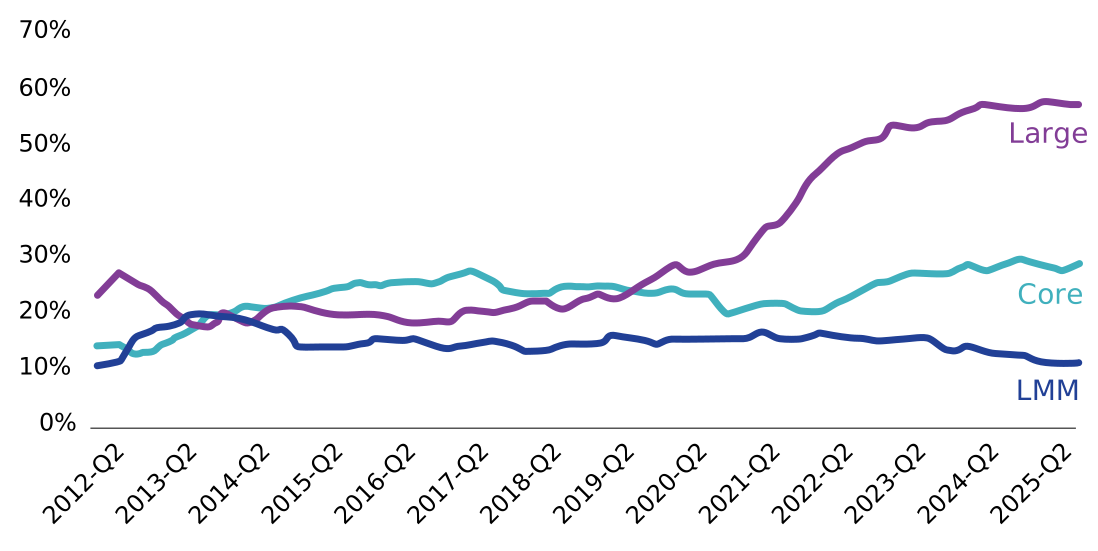
2 Company Filings and Raymond James Research
For investors allocating capital across multiple large private credit platforms, portfolio overlap can create unintended concentration risk. Investing with two or more managers does not necessarily ensure diversification if each manager is operating in the same crowded segment of the market and participating in the same syndicated transactions.
This overlap is not a reflection of manager oversight or inefficiency. Rather, it is a structural outcome of a concentrated opportunity set and the widespread use of syndication in the upper middle market. The key takeaway for investors is that manager selection alone may not fully address diversification risk if exposure is concentrated in the same market segment.
The broader middle market consists of nearly 200,000 companies, representing approximately one-third of the U.S. economy and generating an estimated $10 trillion in annual revenue.3 Within this universe, the core middle market (companies with $10 to $50 million of annual earnings) remains meaningfully underserved by traditional lenders.
With less competition from banks and large asset managers, this segment offers:
Private credit opportunities vary widely by market segment, and not all areas of the market are created equal. Investors should carefully consider how capital concentration and competitive dynamics may affect portfolio outcomes, particularly in saturated segments such as the upper middle market.
PennantPark has focused on the core middle market for nearly two decades, navigating multiple credit cycles including the Global Financial Crisis, the post-2010 expansion, and the COVID-19 downturn. Throughout these periods, our disciplined, relationship-driven approach has remained consistent, supporting a resilient and durable lending platform.
We welcome a conversation; please contact invest@pennantpark.com or the professionals listed below.
3 National Center For the Middle Market, 4Q 2023 Middle Market Indicator Report
PennantPark was founded in 2007 as an independent middle market credit platform. The firm was founded by Art Penn, a private credit industry veteran that previously co-founded Apollo Investment Management. We have invested over $26 billion across multiple economic and credit cycles since inception, and we manage $10 billion in AUM today.[i] PennantPark serves a broad range of sophisticated investors with product offerings that include business development companies, private capital funds, joint ventures, and other specialized funds.
Our highly experienced team primarily invests in the core middle market, targeting companies with earnings of $10 million to $50 million. These mid-sized companies are often overlooked by banks and large investment managers, resulting in senior secured loans that generally feature higher yields, lower leverage, and stronger lender protections when compared to the upper middle market and broadly syndicated loans. We focus on five key industry verticals where our track record is excellent and where we have the most expertise and experience. These industries include healthcare, government services, business services, consumer, and software & technology.




©2026 PennantPark Investment Advisers, LLC (‘PennantPark’) is an investment adviser registered with the US Securities and Exchange Commission (‘SEC’). Registration is not an endorsement by the SEC nor an indication of any specific level of skill. Products or services referenced in this document may not be licensed in all jurisdictions, and unless otherwise indicated, no regulator or government authority has reviewed this document, or the merits of the products and services referenced herein. This document and the information contained herein has been made available in accordance with the restrictions and/or limitations implemented by applicable laws and regulations.
In considering the past performance information contained herein, recipients should bear in mind that past performance is not a guarantee, projection or prediction and it is not a guarantee or indication of future results. Invested capital is at risk. There can be no assurance that any product or service referenced herein will achieve comparable results, or that they will be able to implement their investment strategies or achieve their investment objectives.
An investment with PennantPark in any advised fund is suitable only for sophisticated investors and requires the financial ability and willingness to accept the risks and lack of liquidity that are characteristic of an investment in such funds. Investors must be prepared to bear such risks for an extended period. There can be no assurance that any investment will be profitable, not lose money, or achieve the other intended purposes for which they are made. Investing with PennantPark will expose the investor to various risks including, but not limed to, the following: 1) Lack of Liquidity Risks including lack of permitted withdrawals, lack of secondary market, and lack of transferability 2) Interest Rate Volatility Risks 3) Use of Leverage Risks 4) Securitization Risks 5) Credit Market Disruption Risks 6) Investing within a Highly Competitive Market Risks 7) Default by Borrowers Risks 8) Recovery on Bad Debt Risks including cost of recovery 9) International Market Exposure Risks 10) Inflation and Deflation Exposure Risks. This is not intended to be a complete description of the risks of investing with PennantPark. Investors should rely on their own examination of the potential risks and rewards. The firm brochure (Form ADV 2A) is available online at www.adviserinfo.sec.gov or upon request and discusses these and other important risk factors and considerations that should be carefully evaluated before making an investment.
This document is directed at and intended for sophisticated investors. The information contained here does not constitute, and is not intended to constitute, an offer of securities and accordingly should not be construed as such. Information in this document does not constitute legal, tax, or investment advice. Before acting on any information in this document, current and prospective investors should inform themselves of and observe all applicable laws, rules and regulations of any relevant jurisdictions or obtain independent tax, legal, or investment advice.
Statements in this document are made as of the date hereof unless stated otherwise herein, and neither the delivery of this Document at any time, nor any sale hereunder, shall under any circumstances create an implication that the information contained herein is correct as of any time after such date. Certain information contained herein concerning economic trends and performance is based on or derived from information provided by independent third-party sources. PennantPark believes that such information is accurate and that the sources from which it has been obtained are reliable. PennantPark cannot guarantee the accuracy of such information, however, and has not independently verified the assumptions on which such information is based. Certain statements contained in this Document, including without limitation, statements containing the words “believes,” “anticipates,” “intends,” “expects,” and words of similar import constitute “forward looking statements.” Additionally, any forecasts and estimates provided herein are forward-looking statements. Such statements and other forward-looking statements are based on available information and the views of PennantPark as of the date hereof. Accordingly, such statements are inherently speculative as they are based on assumptions that may involve known and unknown risks and uncertainties. Actual results and events may differ materially from those in any forward-looking statements. Further, any opinions expressed are the current opinions of PennantPark only and may be subject to change, without notice. There is no undertaking to update any of the information in this document. No person has been authorized in connection with this document to give any information or to make any representations other than as contained in this document and, if given or made, such information or representation must not be relied upon as having been authorized by PennantPark Investment Advisers, LLC (“PennantPark”) or PennantPark’s affiliates.